
0

Blog - CPD Learning & Professional Development Tips at Laser Short Courses
Recent Posts
More...
A Post for Testing
Thursday 23rd April, 2026
SEND awareness
Tuesday 18th February, 2025

BIG emotions
Wednesday 15th January, 2025

Inclusive language when talking about families
Tuesday 14th January, 2025

New Year: New skills, knowledge, and confidence!
Friday 20th December, 2024
New e-Book for parents and carers: Visual daily planners
Wednesday 24th July, 2024
Course update: Supporting children on the autism spectrum
Thursday 11th April, 2024
The revised EYFS framework 2024
Friday 12th January, 2024

Upskilling Into the World of Human Resources
Tuesday 28th November, 2023

Black Friday weekend offer
Wednesday 22nd November, 2023

The Care Certificate on Laser Short Courses
Tuesday 26th September, 2023
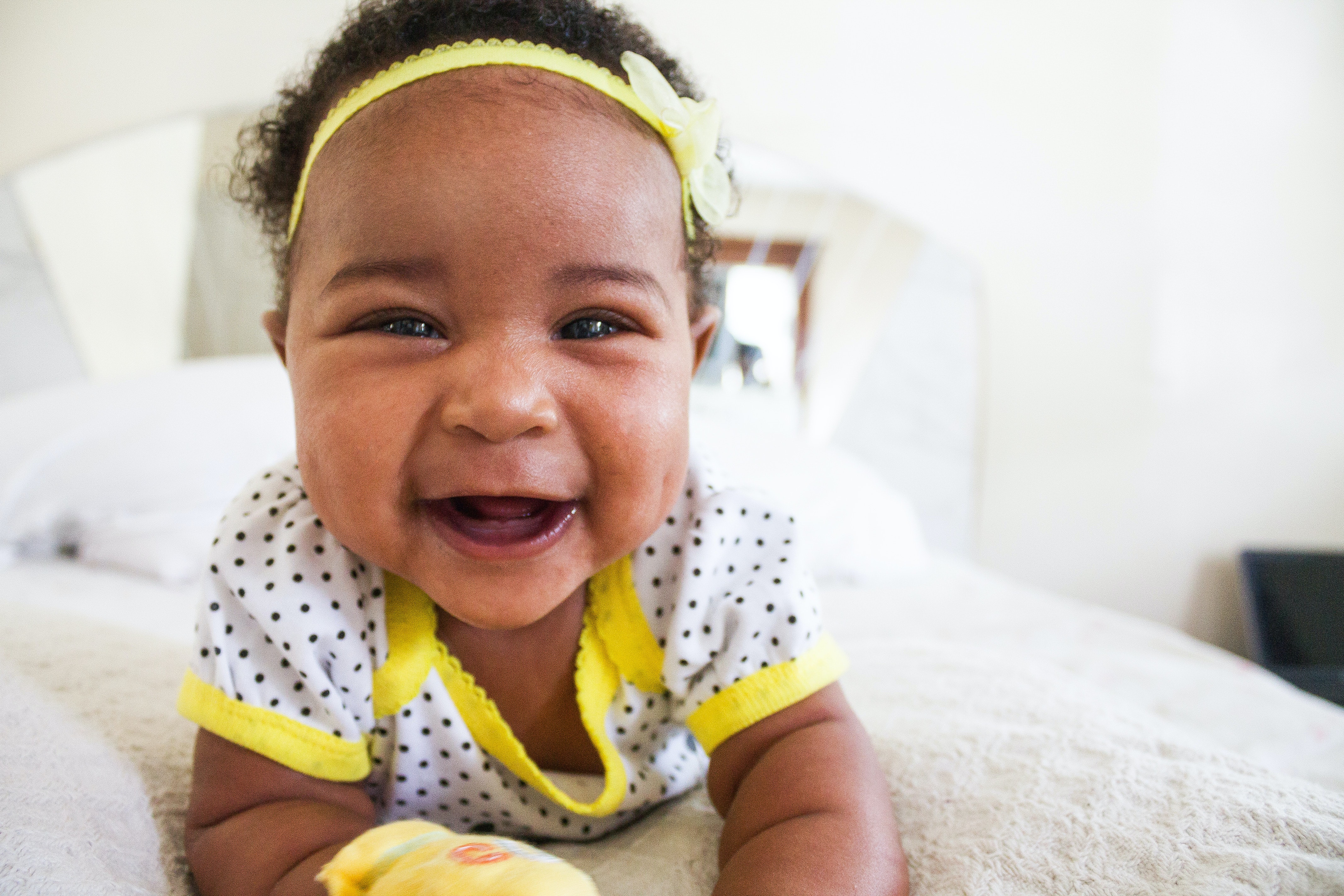
Ofsted report: The 3 prime areas of learning
Friday 15th September, 2023
Business course review
Wednesday 2nd August, 2023

FREE e-Book: ‘Understanding sleep safety for babies’
Tuesday 18th July, 2023
Recent changes to the Laser Short Course site
Monday 10th July, 2023

BNF Healthy eating week recipes
Wednesday 7th June, 2023

FREE e-Books by Laser Learning
Wednesday 31st May, 2023

Understanding cognitive development in children
Friday 26th May, 2023
We’re #CelebratingSocialCare this April
Saturday 1st April, 2023

Crackin’ Easter activities
Thursday 23rd March, 2023
Posts By Month
SEND awareness
Tuesday 18th February, 2025
Special Educational Needs and Disabilities, also known as SEND, refers to a range of different conditions affecting children and young people that may result in them requiring additional support to learn and develop. You will often hear the acronym SEND used in educational and care settings as a reference to the SEND system of support offered to children and young people aged 0-25 years.
You may also be aware of the ‘SEND Code of Practice’ that provides advice and statutory guidance for how best to identify and support children and young people in settings that care for, teach, and support them. But, what conditions are actually categorised as SEND in this country? Any medical condition that affects a child’s ability to learn would be considered SEND. Specifically, any condition that affects a child’s: •
- Behaviour and mental health, such as Obsessive Compulsive Disorder (OCD)
- Communication and ability to socialise, such as Autism Spectrum Condition (ASC)
- Reading and writing, such as Dyslexia • Sensory impairment, such as partial sight loss
- Cognition and learning, such as Down Syndrome
- Concentration levels, such as Attention Deficit Hyperactivity Disorder (ADHD)
Physical ability, such as Dyspraxia SEND can also affect a child’s ability to access facilities, public spaces, and the curriculum.
A children with SEND may experience mild to moderate impact on their health, wellbeing, and ability to learn, or it may be more severe. Needs may also change over time, and some children may need more or less support than others. The most important thing to remember is every child is unique, and has unique support needs.
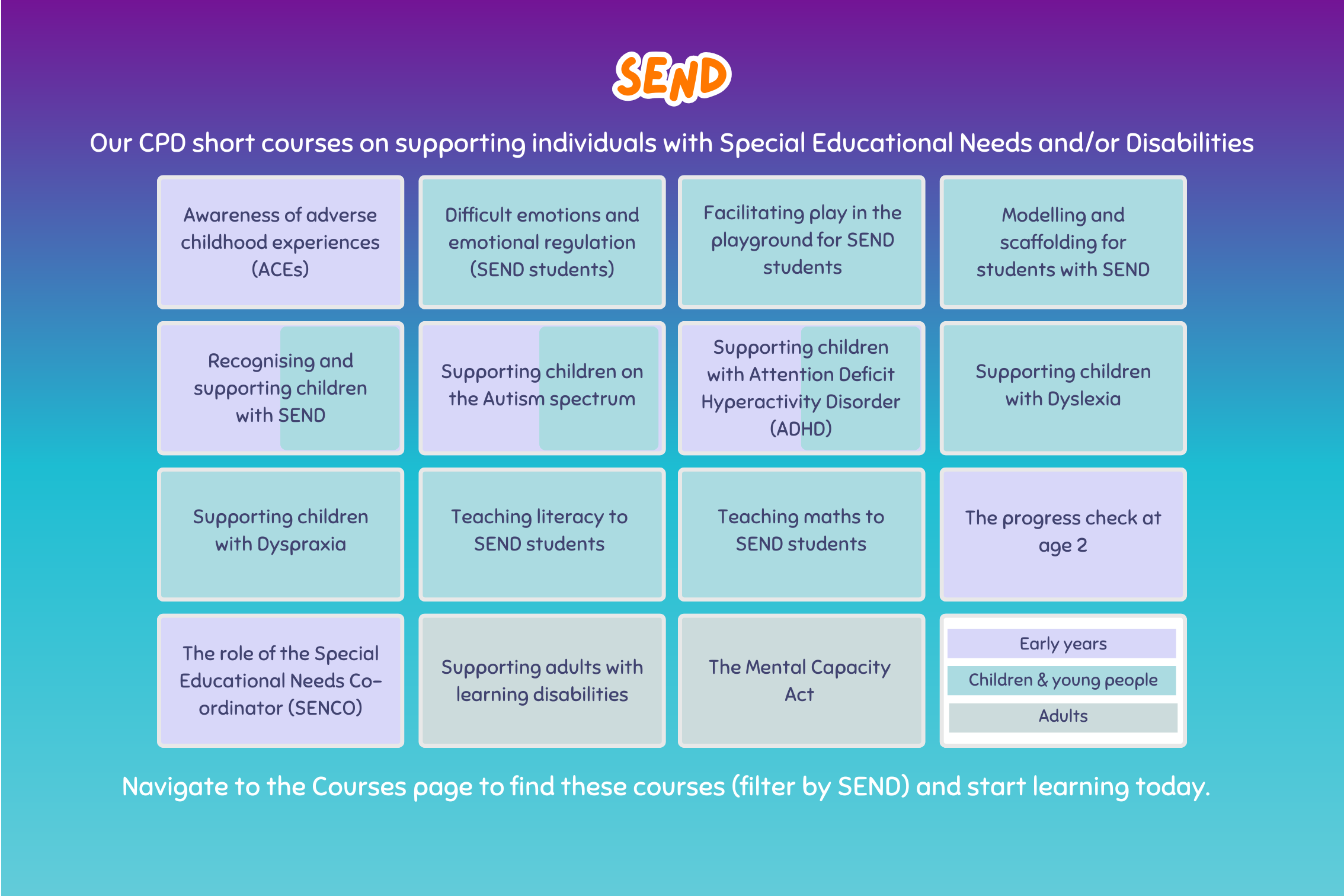
SEND covers a broad and diverse range of needs, and it is important to note that a child with a condition categorised as SEND can still thrive and achieve in education and in later life. We need to make sure they are well supported and remove barriers to learning to give these children and young people the best chance of positive outcomes. If you would like to learn more about supporting individuals with SEND, Laser Short Courses has a number of excellent courses on the topic.
Short Courses Unlimited
Unlock over 150 high quality CPD short courses.
Enjoy unrestricted access to our full course library from just £9.99 per month.
BIG emotions
Wednesday 15th January, 2025
We all have big emotions that are difficult to control and manage sometimes. Even as adults, we can be consumed by these feelings and express them in an unfiltered way that may surprise those around us. For children and young people who have a condition associated with emotional dysregulation, or who haven’t fully developed self-regulation skills – big emotions can result in strong emotional expression.
When in a heightened state of emotion, the part of the brain that is concerned with logical thinking and controlling actions (prefrontal cortex) goes ‘offline’ and is impaired by chemicals released during stress. This means that the child will really struggle to control their actions and it’s very likely they will have an outburst.
To parents and those of us who work with children, this may look like:
- Tantrums
- Crying uncontrollably
- Freezing and not engaging with you
- Laughing or smiling at inappropriate moments
- Withdrawing from social interactions and activities
- Arguing, bickering, and snapping at people around them
- Running away or hiding when in a busy and overwhelming environment
When someone is behaving in these ways, they are trying to communicate that they are not ok and need some help with their big emotions. The more you support someone with their big emotions, the more able they are to regulate their emotions in the future.
Caregivers have been told in the past to ignore a child who is having a ‘tantrum’ or ‘acting out’ and give them a time out so they learn to calm down by themselves. But, more modern childcare advice recommends helping the child understand and manage their big emotions instead. In practice, this means naming emotions and helping them to learn ways to describe their feelings using their preferred communication style.
<img src="/img/3rs.png" width="100%">
When supporting children and young people to manage their emotions, one of the most important things to remember is that you’re helping them to regulate and manage their emotions, not ‘control’ them. Asking children to ‘control’ themselves may result in pushing down the emotion, not processing it, and using a lot of willpower and self-control that they just don’t have in the moment. Managing the emotion allows them to release the energy and adrenaline that comes with the emotion, and find ways to understand and process it. Strong emotions, like anger and anxiety, are often the body’s way of preparing us for action in response to a danger or threat. That is very difficult to ignore and by asking a child to ‘control’ their emotions, we’re asking them to react in a completely unnatural way.
If you would like to learn more about big emotions and strategies that can help with managing emotions, you might like to take our short course on <a href=" http://www.lasershortcourses.co.uk/course.php?c=LSC.IP3.2"> Managing behaviour</a> or <a href=" http://www.lasershortcourses.co.uk/course.php?c=LSC.IP3.120"> Big emotions and emotional regulation (for SEND students)</a>.
Inclusive language when talking about families
Tuesday 14th January, 2025
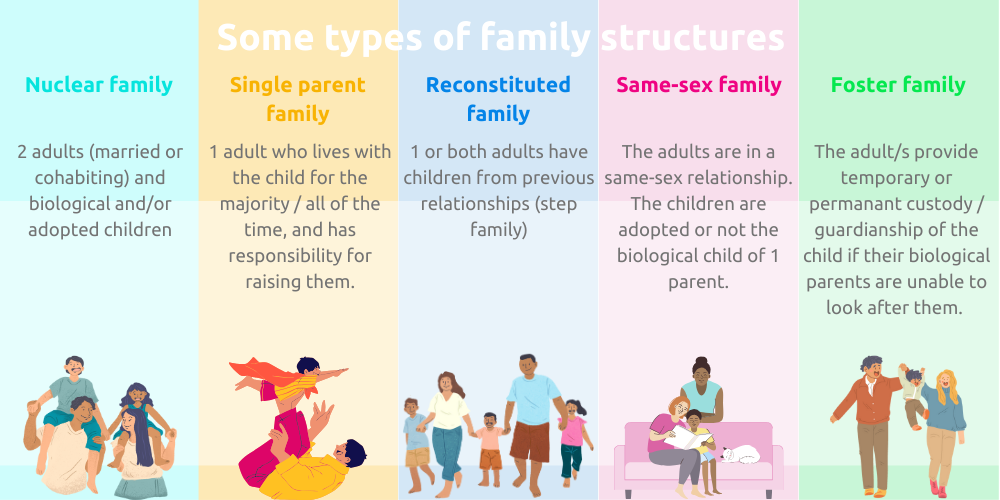
Anyone who works in education will be in contact with the child or young person’s family, and will also talk to the child about their home life. It can be easy to slip into a habit of using ‘Mum and Dad’ if you grew up in a nuclear family, and even if you didn’t, you may say it out of habit if you’re influenced (as we all are) by the language those around us use. Many of us use non-inclusive language in our daily lives without thinking, and it doesn’t make us ‘bad’ or insensitive – we’re deeply influenced, often subconsciously, by our backgrounds and experiences – but it can be hurtful to those who aren’t being included in the language we use.
It's ok to make a mistake and correct yourself, or be corrected by someone else and learn something. What’s not ok is repeatedly making the same mistake and not reflecting on it or learning from it. It's important to stop and think about the language we’re using in our practice, and consider if we have any unconscious bias or pre-conceived ideas that may be making others feel judged, hurt, or not included. How do you think it would make a child who is being cared for by a foster family feel if you used ‘Mum and Dad’? How would a child in a single parent family feel? What about a child who lost a parent?
Words have power and this can be both positive and negative. How would those same children feel if you used ‘parent or carer’? Hopefully, they would feel seen, heard, and included. And would feel like you’re being considerate to different family structures.
The types of families we encounter, or may belong to, has changed considerably in the past century as attitudes to marriage, divorce, family life, and sexuality have also changed as we become a more tolerant society. There is still work to be done, but society is more accepting of different ways to live and understanding of people who have different lifestyles to our own.
We are also seeing an increase in the number of children in care, with foster care being the most common placement type. A study published in The Lancet in 2022 concluded that 10,000 children entered the care system for reasons linked to poverty in the five-year period from 2015 to 2020. With the cost of living crisis and austerity cuts, the number of care in care is sadly, predicted to rise.
As such, we should be sure that the language we use when talking about families and home life includes every child in the classroom, no matter what their individual circumstance is. We want children and young people to feel safe at school or college, protected from discrimination, and for it to be a place where they are welcomed and included. A small action we can take here is to ask them for their preference on how they would like you to talk about their family, home life, and if they are in care, the terminology they prefer. If in doubt – ask!
Children in care
For example, many children feel that the official government term ‘Looked After Children (LAC)’ makes them feel different, stigmatised, and defined by care system language. According to the NSPCC, children in care are already particularly vulnerable to exclusion and discrimination from their peers and in the community, simply by virtue of being looked after. So, how we discuss and speak to children in care is particularly important.
Whenever we refer to a child by a label or acronym, we are grouping them together and not recognising them as an individual with their own unique experiences and characteristics. The acronym ‘LAC’ can be particularly harmful as it can make a child feel like they are LAC-king something, when they’re not. It also risks practitioners and educators seeing a child in care in a certain way, and making assumptions. Whilst it’s true that the experience of being in care can be traumatic and may affect the health, wellbeing, and development of a child, this isn’t true of all children in care.
Each individual's experiences and resilience will differ, and being a child in care doesn’t always mean that the child will struggle with some aspects of their development, such as emotional development. Many children in care form close relationships with their new families and carers, and other trusted adults, such as teachers and social workers, and with the right support they develop positive self-esteem, emotional regulation and awareness, resilience, and continue to thrive in adulthood. They can also develop healthy coping mechanisms, and are highly adaptable and determined to overcome challenges.
Tips for inclusive language:
• Use person-first language (such as a child in care), rather than identify-first language (A looked after child)
• Avoid labelling or using acronyms when talking to the individual or in the classroom. There is no need to mention a child’s family structure unless it’s relevant to the discussion. Understandably, you may need to use acronyms for ease and time when talking to other professionals and your colleagues.
• Challenge biases and reflect on the language you, your colleagues, the other children and young people, and the school uses
• Just as you would avoid assumptions about the child’s gender or sexual orientation, you should avoid assumptions about their parent/s or carer/s. This allows for people who identify as LGBTQIA+ to feel included.
• Avoid assumptions about biological parents and be mindful of the fact that some children don’t live with their biological parents, and may have experienced loss and bereavement. Instead of saying ‘Mum’ or ‘Dad’, consider using more neutral terms like ‘parent’, ‘guardian’, ‘caregiver’, or ‘carer’.
• Don’t assume the relationship status of the parent or carer – many people have children before marriage or civil partnership, and/or don’t plan to enter into a legal partnership. There are also many people who divorce or separate from the partner they had a child with, or choose to have a child as a single parent.
• Respect the privacy of children and their families and don’t force them to share details about their lives with you or their peers if they don’t feel comfortable doing so. If they do choose to share, encourage the class to actively listen, and be respectful and understanding.
• Recognise lived experience – there is a chance you may have a child in care at your school who was an unaccompanied asylum seeker or has refugee status. These children shouldn’t be defined by this.
• We may not always get it right, and what’s right for one person may not be for another. If in doubt – ASK!
If you would like to learn more about inclusive practice when working with children in care, you may be interested in our latest short course Children in care / Looked After Children in education.
References:
- ‘Child poverty and children entering care in England, 2015–20: a longitudinal ecological study at the local area level’ by Davara L Bennett, et. al, June 2022
- ‘Why language matters: why you should avoid the acronym 'LAC' when talking about children in care’ on the NSPCC website
- ‘Inclusive Language Examples: How to Be More Inclusive in the Classroom’ by Amie Jo-Angel, published on the TWINKL website
Short Courses Unlimited
Unlock over 150 high quality CPD short courses.
Enjoy unrestricted access to our full course library from just £9.99 per month.
New Year: New skills, knowledge, and confidence!
Friday 20th December, 2024
It’s easy to get swept-up in the ‘new year, new you’ mindset in January, especially with an influx of marketing messages encouraging you to ‘change’. It can feel overwhelming and can spark negative thoughts and feelings about yourself, rather than focusing on areas of strengths that you can build on and opportunities in your life that you can make the most of. Focusing on growth and development, rather than complete change, is a healthier way to ease yourself into a new year with a positive start.
Your personal New Year’s Day can start at any time!
It is also important to remember that your new year can start at any time. Every day is a chance to start again and take a tiny step towards a greater goal. As long as you look at your goals as ongoing and remember that you are developing more than one single outcome, you can continue to make positive developments and changes throughout the year and maybe achieve so much more than you initially thought was possible.
“A journey of a thousand miles begins with a single step” (Chinese proverb)
Small steps can make a big impact over time, so break down goals into smaller, more achievable steps that fit in with your life and daily responsibilities. Finding the time to invest in expanding your knowledge and gaining new skills will have a positive impact on your new year. No matter how small you start, your effort over time will have a significant impact, increase your confidence, and give you the tools to pursue further goals in the future.
Completing an online short course is a small, positive step you can take in reaching your goals for the year. Feeling a sense of achievement by successfully completing a course will give you the confidence boost needed to stay on track for your journey this year.
Learn something new at the start of 2025
Laser Short Courses offers over 150+ courses on childcare, education, health and social care, compliance, and business topics. Our courses are flexible, self-guided bursts of e-learning designed to support your continuous development and they do not have an expiry date – just like learning!
To help you make that first positive step in achieving your 2025 goals, we would like to offer you 50% OFF any short course of your choice in January!
Discount code: NEWYEAR25